Research
My research sorted by year.
2026
-
 Track me if you can: Ephemeral coin tracingIgnacio Amores-Sesar, Christian Cachin, Rohit Chatterjee, Luiza Soezima, François-Xavier Wicht, and Michelle Yeo2026Under submission
Privacy-preserving payment systems are well understood, yet their adoption in regulated settings, such as central bank digital currencies (CBDCs), institutional stablecoins, and other compliant payment infrastructures, has been limited by concerns over their potential misuse for illicit activities. Regulators counter financial crime with a toolbox of complementary measures to identify, trace, and stop criminal actors. Tracing is one key tool: acting on outside evidence that a user is implicated in a crime such as money laundering, law enforcement follows the suspect’s funds through the ledger to uncover laundering routes and accomplices. The tracing schemes proposed in the literature, however, grant authorities unbounded capabilities: once initiated, tracing propagates through the transaction graph or persists across all future transactions of a user, and may eventually deanonymize the entire ledger. Only the goodwill of the authority, or the honesty of a committee, keeps surveillance targeted and temporary. We introduce ephemeral coin tracing (ECT), a primitive whose tracing capacity is bounded by construction, both in the number of simultaneously traced users and in the number of hops each trace survives. The authority issues tracing tags that degrade at each hop; after a protocol-defined number of hops, a tag collapses into a value indistinguishable from that of an untagged coin. Within a tracing period the bound is absolute: no authority, however motivated, can follow a tag past its budget. We formalize ECT, define its security and privacy guarantees, and give two constructions, one over exponential ElGamal and one over Damgård-Jurik encryption.
@unpublished{accswy26, author = {Amores{-}Sesar, Ignacio and Cachin, Christian and Chatterjee, Rohit and Soezima, Luiza and Wicht, Fran{\c{c}}ois{-}Xavier and Yeo, Michelle}, title = {Track me if you can: Ephemeral coin tracing}, note = {Under submission}, year = {2026}, eprint = {2026/1645}, } -
 The Consensus Number of Untraceable CryptocurrenciesIn Proc. 8th Conference on Advances in Financial Technologies (AFT 2026), 2026
Sender untraceability hides the account spent by a cryptocurrency transfer among a set of candidates, its masking set. What a transfer does to that set separates two designs: classical schemes retain the whole set and append a nullifier marking the spent account, so the ledger grows with every transfer; constant-state schemes instead consume and replace the entire set. We ask how this choice affects synchronization. We formalize the two designs as the linear and constant untraceable asset transfer objects (LUAT and CUAT) and locate them in the consensus hierarchy. In LUAT, transfers from distinct accounts commute. Its consensus number is 2, compared with 1 for standard asset transfer, independently of the masking-set size and of the untraceability notion, and LUAT is starvation-free. Partitioning the accounts into fixed masking sets lets exhausted sets be garbage-collected without increasing that number. In CUAT, a transfer consumes and replaces every account of its masking set, so two transfers whose sets intersect cannot both take effect. We formalize this with the conflict graph on masking sets, whose edges join sets sharing an account. Under weak untraceability, which protects a transaction in isolation, the consensus number is unbounded already for one-round protocols. Under strong untraceability, which protects against an observer of the complete history, untraceability holds on a history exactly when any two accounts sharing a masking set occur in the same number of the masking sets in it. This uniform incidence bounds the conflict graph, and matching constructions attain it, so the consensus number is determined exactly and grows quadratically in the masking-set size. Finally, CUAT is not starvation-free. The two objects therefore pay for the same privacy differently: LUAT in storage, CUAT in synchronization and fairness.
@inproceedings{clvw26, author = {Cachin, Christian and Lehnherr, David and Villacis, Juan and Wicht, Fran{\c{c}}ois{-}Xavier}, title = {The Consensus Number of Untraceable Cryptocurrencies}, booktitle = {Proc.\ 8th Conference on Advances in Financial Technologies ({AFT}~2026)}, year = {2026}, eprint = {2026/1503}, } -
 Persistent BitTorrent TrackersFrançois-Xavier Wicht, Zhengwei Tong, Shunfan Zhou, Hang Yin, and Aviv YaishIn 2026 IEEE 11th European Symposium on Security and Privacy (EuroS&P), 2026
Private BitTorrent trackers enforce upload-to-download ratios to prevent free-riding, but suffer from three critical weaknesses: reputation cannot move between trackers, centralized servers create single points of failure, and upload statistics are self-reported and unverifiable. When a tracker shuts down, users lose their contribution history and cannot prove their standing to new communities. We address these problems by storing reputation in smart contracts and replacing self-reports with cryptographic attestations. Peers sign receipts for received pieces; the tracker aggregates them via BLS signatures and updates reputation. If a tracker is unavailable, peers fall back to an authenticated distributed hash table (DHT): stored reputation acts as a public key infrastructure (PKI), preserving access control without the tracker. Reputation is portable across tracker failures through single-hop migration in factory-deployed contracts. We also address the privacy implications of publishing public keys and reputations tied to private trackers on a public ledger: we propose ephemeral session keys to prevent linking peer identities, zero-knowledge membership proofs for anonymous DHT participation, and confidential reputation using homomorphic commitments. We formalize the security requirements, prove four security properties under standard cryptographic assumptions, and evaluate a prototype. Measurements show that transfer receipts add less than 5% end-to-end overhead with typical piece sizes. To minimize signing overhead, we adopt a hybrid signature scheme: ECDSA signs individual piece receipts at transfer time for low per-operation latency, while BLS serves as the overarching scheme, enabling compact aggregation of many receipts into a single proof at report time. This design reduces client-side signing cost by an order of magnitude compared to using BLS throughout.
@inproceedings{wtzyy26,
  author = {Wicht, François-Xavier and Tong, Zhengwei and Zhou, Shunfan and Yin, Hang and Yaish, Aviv},
  booktitle = {2026 IEEE 11th European Symposium on Security and Privacy (EuroS&P)},
  title = {Persistent BitTorrent Trackers},
  year = {2026},
  volume = {},
  number = {},
  eprint = {2025/2131},
  pages = {419-435},
  keywords = {Contracts;Smart contracts;Public key;Arrays;Security;Costing;Costs;Cryptography;Printing;Timing;p2p;file transfer;censorship resistance;persistent reputation management;distributed file exchange},
  doi = {10.1109/EuroSP68448.2026.00035},
}
2025
-
 Toxic Decoys: A Path to Scaling Privacy-Preserving CryptocurrenciesChristian Cachin and François-Xavier WichtProc. Priv. Enhancing Technol., 2025
Anonymous cryptocurrencies attracted much attention over the past decade, yet ensuring both integrity and privacy in an open system remains challenging. Their transactions preserve privacy because they do not reveal on which earlier transaction they depend, specifically which outputs of previous transactions are spent. However, achieving privacy imposes a significant storage overhead due to two current limitations. First, the set of potentially unspent outputs of transactions grows indefinitely because the design hides cryptographically which one have been consumed; and, second, additional data must be stored for each spent output to ensure integrity, that is, to prevent that it can be spent again. We introduce a privacy-preserving payment scheme that mitigates these issues by randomly partitioning unspent outputs into fixed-size bins. Once a bin has been referenced in as many transactions as its size, it is pruned from the ledger. This approach reduces storage overhead while preserving privacy. We first highlight the scalability benefits of using smaller untraceability sets instead of considering the entire set of outputs, as done in several privacy-preserving cryptocurrencies. We then formalize the security and privacy notions required for a scalable, privacy-preserving payment system and analyze how randomized partitioning plays a key role in both untraceability and scalability. To instantiate our approach, we provide a construction based on Merkle trees, which ensures efficient argument systems and easy pruning of the state. We finally show the storage benefits of our scheme and analyze its resilience against large-scale flooding attacks using empirical transaction data.
@article{cw25, author = {Cachin, Christian and Wicht, Fran{\c{c}}ois{-}Xavier}, title = {Toxic Decoys: {A} Path to Scaling Privacy-Preserving Cryptocurrencies}, journal = {Proc. Priv. Enhancing Technol.}, volume = {2025}, number = {4}, pages = {926--943}, year = {2025}, url = {https://doi.org/10.56553/popets-2025-0165}, doi = {10.56553/POPETS-2025-0165}, eprint = {2025/1124}, } -
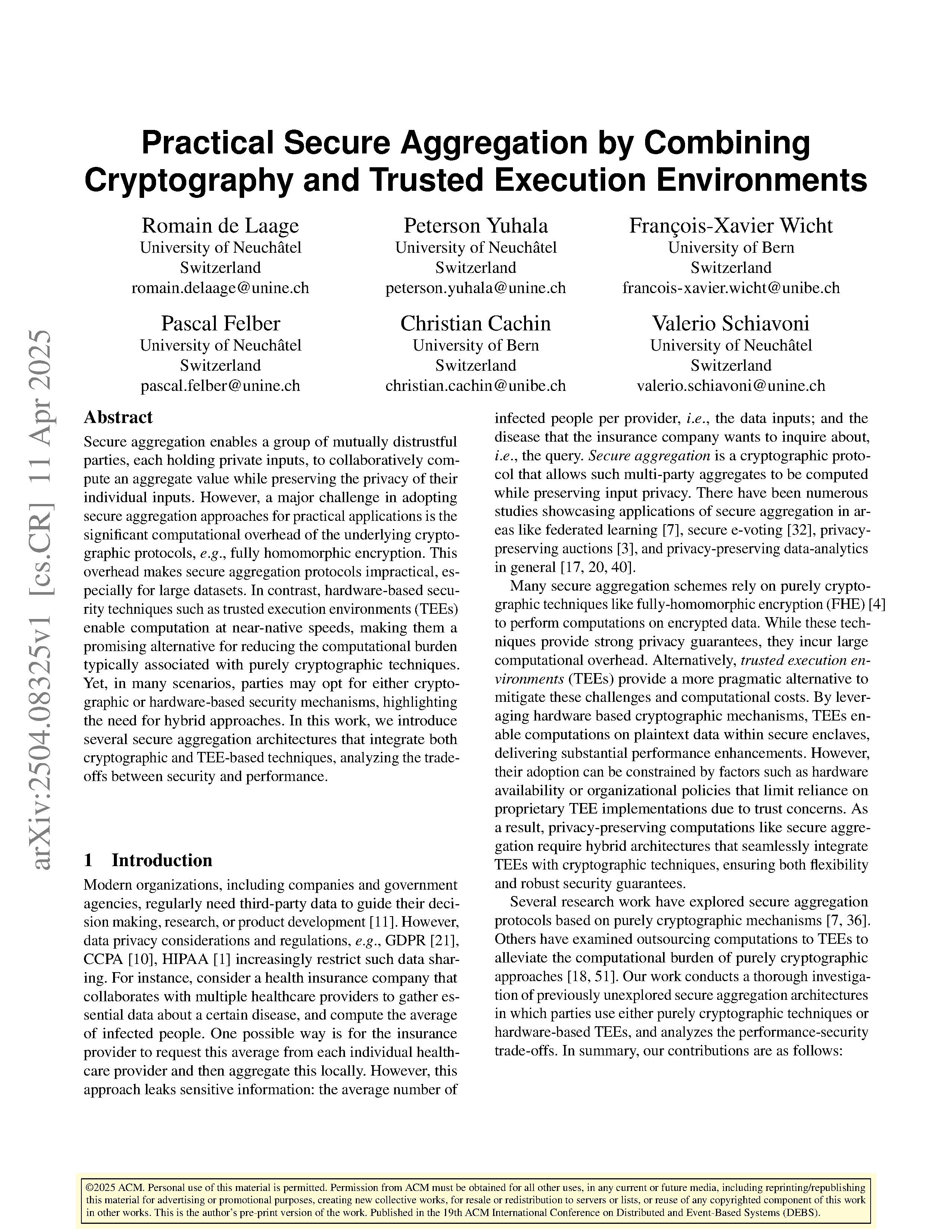 Practical Secure Aggregation by Combining Cryptography and Trusted Execution EnvironmentsRomain Laage, Peterson Yuhala, François-Xavier Wicht, Pascal Felber, Christian Cachin, and Valerio SchiavoniIn Proceedings of the 19th ACM International Conference on Distributed and Event-based Systems, DEBS 2025, Gothenburg, Sweden, June 10-13, 2025, 2025
Secure aggregation enables a group of mutually distrustful parties, each holding private inputs, to collaboratively compute an aggregate value while preserving the privacy of their individual inputs. However, a major challenge in adopting secure aggregation approaches for practical applications is the significant computational overhead of the underlying cryptographic protocols, e.g. fully homomorphic encryption. This overhead makes secure aggregation protocols impractical, especially for large datasets. In contrast, hardware-based security techniques such as trusted execution environments (TEEs) enable computation at near-native speeds, making them a promising alternative for reducing the computational burden typically associated with purely cryptographic techniques. Yet, in many scenarios, parties may opt for either cryptographic or hardware-based security mechanisms, highlighting the need for hybrid approaches. In this work, we introduce several secure aggregation architectures that integrate both cryptographic and TEE-based techniques, analyzing the trade-offs between security and performance.
@inproceedings{lywfcs25,
  author = {de Laage, Romain and Yuhala, Peterson and Wicht, François-Xavier and Felber, Pascal and Cachin, Christian and Schiavoni, Valerio},
  title = {Practical Secure Aggregation by Combining Cryptography and Trusted Execution Environments},
  booktitle = {Proceedings of the 19th {ACM} International Conference on Distributed and Event-based Systems, {DEBS} 2025, Gothenburg, Sweden, June 10-13, 2025},
  publisher = {{ACM}},
  year = {2025},
  doi = {10.1145/3701717.3730543},
  url = {https://doi.org/10.48550/arXiv.2504.08325}
}
2024
-
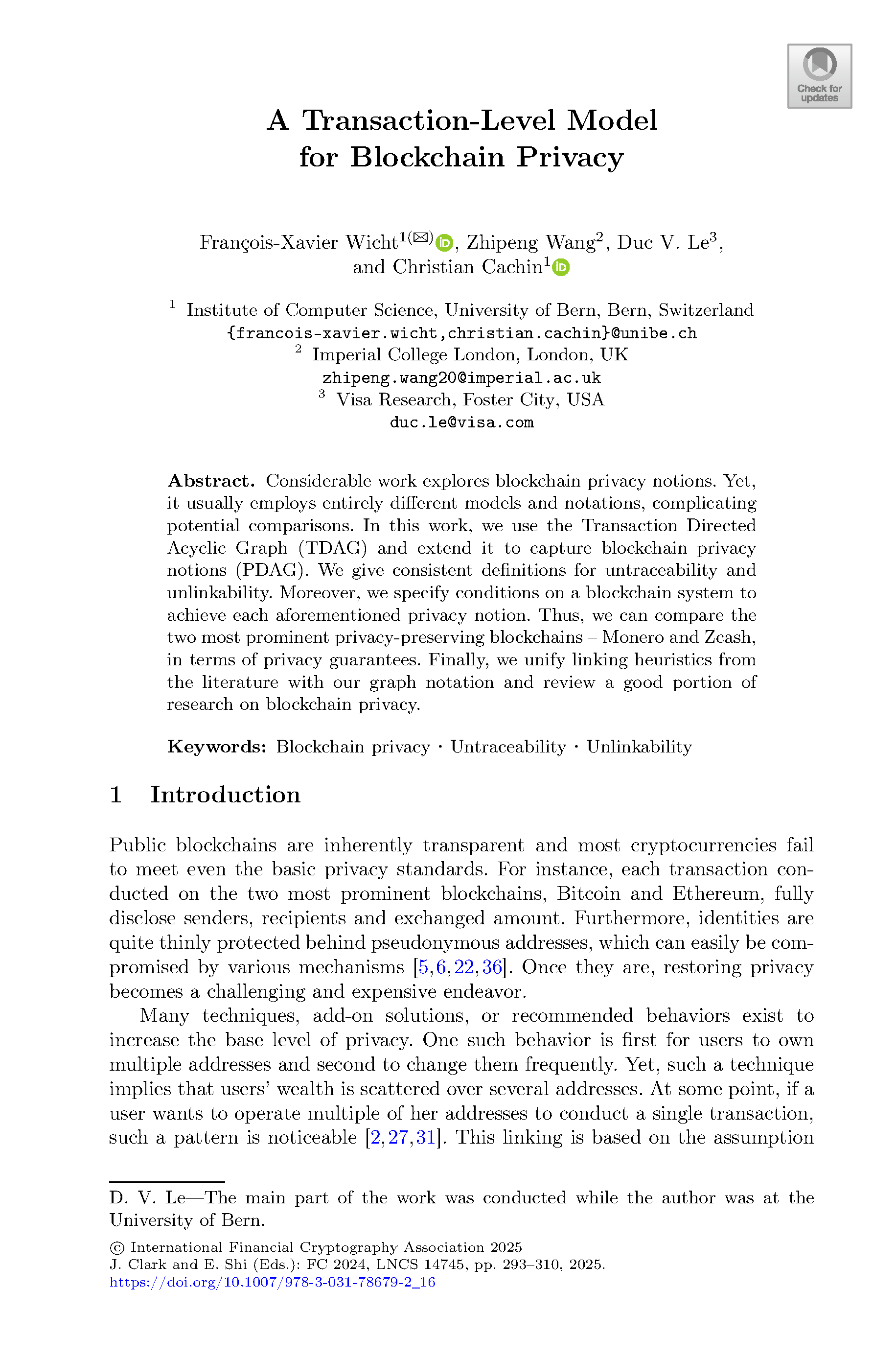 A Transaction-Level Model for Blockchain PrivacyIn Financial Cryptography and Data Security - 28th International Conference, FC 2024, Willemstad, Curaçao, March 4-8, 2024, Revised Selected Papers, Part II, 2024
Considerable work explores blockchain privacy notions. Yet, it usually employs entirely different models and notations, complicating potential comparisons. In this work, we use the Transaction Directed Acyclic Graph (TDAG) and extend it to capture blockchain privacy notions (PDAG). We give consistent definitions for untraceability and unlinkability. Moreover, we specify conditions on a blockchain system to achieve each aforementioned privacy notion. Thus, we can compare the two most prominent privacy-preserving blockchains – Monero and Zcash, in terms of privacy guarantees. Finally, we unify linking heuristics from the literature with our graph notation and review a good portion of research on blockchain privacy.
@inproceedings{DBLP:conf/fc/WichtWLC24,
  author = {Wicht, Fran{\c{c}}ois{-}Xavier and Wang, Zhipeng and Le, Duc Viet and Cachin, Christian},
  editor = {Clark, Jeremy and Shi, Elaine},
  title = {A Transaction-Level Model for Blockchain Privacy},
  booktitle = {Financial Cryptography and Data Security - 28th International Conference,
                    {FC} 2024, Willemstad, Cura{\c{c}}ao, March 4-8, 2024, Revised Selected
                    Papers, Part {II}},
  series = {Lecture Notes in Computer Science},
  pages = {293--310},
  publisher = {Springer},
  year = {2024},
  url = {https://doi.org/10.1007/978-3-031-78679-2_16},
  doi = {10.1007/978-3-031-78679-2_16},
  eprint = {2023/1902},
  timestamp = {Tue, 05 Aug 2025 22:39:13 +0200},
  biburl = {https://dblp.org/rec/conf/fc/WichtWLC24.bib},
  bibsource = {dblp computer science bibliography, https://dblp.org},
  class = {2}
}